
Mixing Peptides: Gotta Keep Them Separated
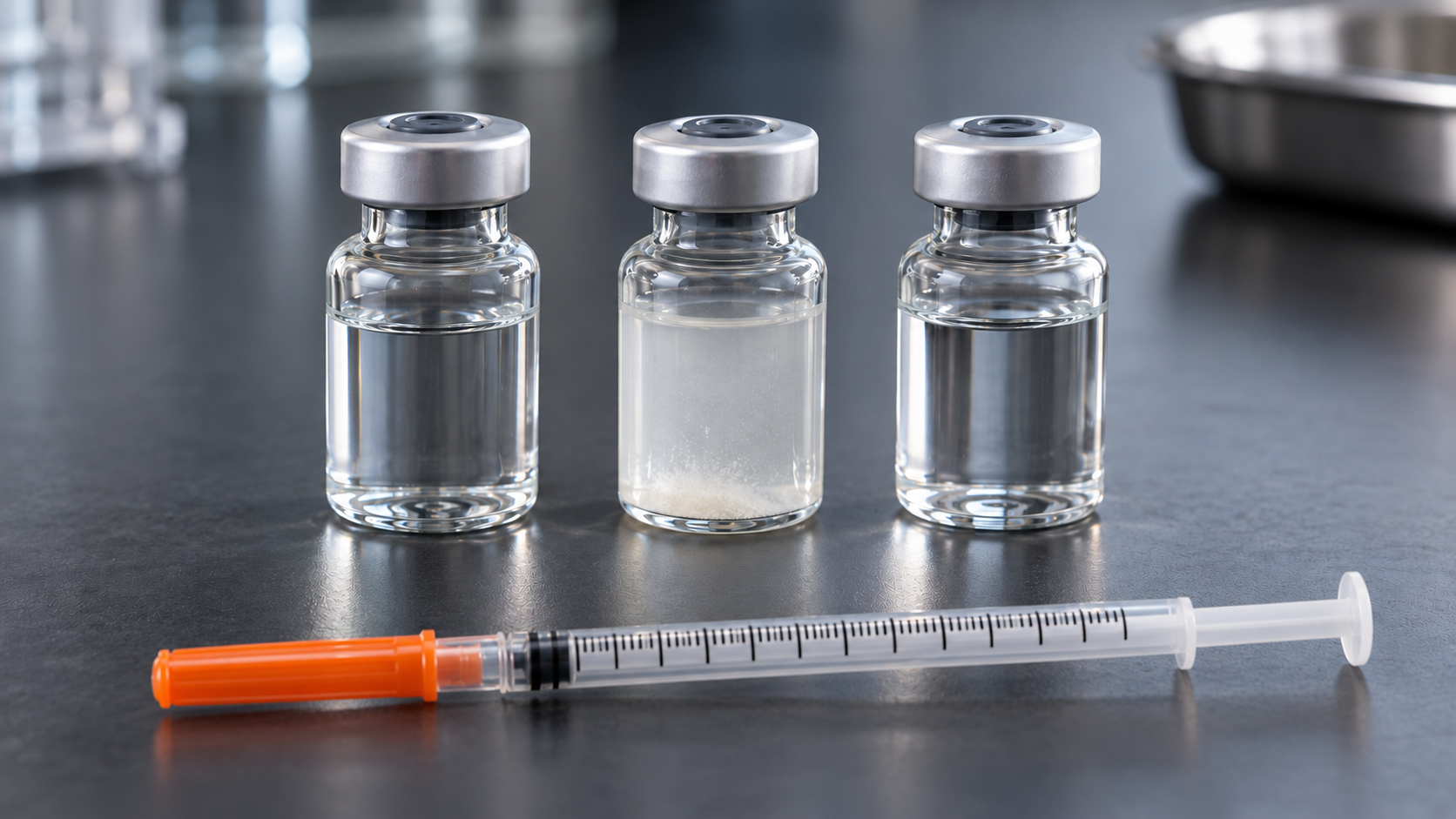
“Can I mix these in the same syringe?”
It’s a common question, and I get why. Fewer injections, less hassle. I’ve done it myself in the past. At this point, though, I wouldn’t combine separately supplied peptides in a syringe or bottle. My only potential exception would be BPC157/TB500 supplied as a formulation developed for use together, with evidence supporting that formulation’s compatibility and stability. Simply selling two or three peptides in the same vial doesn’t establish either.
The issue is rather straightforward: compatibility is a property of the complete formulation. Two compounds being used during the same period tells us very little about what happens when they sit together in solution, whether that be for thirty seconds in a syringe or thirty days in a vial.
Peptides depend on their chemical environment. Combining solutions can change pH, salt concentrations and the concentrations of buffers or other stabilizers. Depending on the molecules and formulation, those changes can promote aggregation, precipitation or chemical degradation. In therapeutic proteins, aggregation is also a recognized concern for immune reactions. That does not mean every small peptide behaves like a large protein, or that every mixture will cause a reaction. It means formulation matters, and we need evidence for the specific combination. [1] A clear syringe doesn’t answer those questions. Visible cloudiness or particles are reasons to stop, but the absence of either doesn’t demonstrate that the compounds have retained their potency or chemical integrity.
A lab report showing “98%” or “99% purity” after a mixture has been stored doesn’t settle the issue either. (I’ve seen this used as an attempt to defend the practice.) If that figure comes from chromatographic peak areas, it speaks to the relative signals detected by that method. It doesn’t establish how much intact peptide remains or whether both peptides retain their activity. Degradation products can go undetected or overlap with the intended peptide’s signal if the method cannot distinguish them. To support stability, testing needs to measure each intact peptide and distinguish it from relevant degradation products in the actual mixture, with comparison to its starting condition. Properly validated testing can provide meaningful evidence. A purity percentage alone cannot. [5]
GHK-Cu deserves particular attention because it adds copper coordination chemistry to the equation. Its copper, in this case, is bound to the peptide, rather than simply floating around as free copper. Research shows that this complex can exchange copper and form additional complexes with other molecules, including histidine-containing sites on albumin. Those findings demonstrate interactions, not proof that every GHK-Cu mixture damages another peptide. [2, 3] Formulation research also shows that GHK-Cu can degrade under basic and oxidative stress. That supports caution about changing its environment, but it doesn’t give us a list of syringe combinations proven safe or unsafe. [4]
Mixing immediately before an injection and storing a combined bottle are different situations. Storage gives potential reactions more time to occur. Brief contact may reduce some time-dependent risks, but “I inject it right away” is still not compatibility testing. The relevant evidence would need to cover the actual ingredients, concentrations, diluent, temperature and contact time.
For someone choosing to use these products, my harm-reduction position is to keep separately supplied peptides separate unless a the manufacturer can provide credible compatibility data for the exact preparation. Separating them avoids the uncertainty introduced by mixing; it doesn’t establish that the products themselves are safe, sterile or effective.
We should be comfortable changing a practice when we have reason to question it. Having done something before is not a reason to keep doing it. Saving an injection is a convenience. For me, that convenience doesn’t justify an untested mixture.
If you need help making sense of peptides, understanding the risks or making more informed decisions about your health and training, reach out today.
Comment below with any peptide-related topics you want Swede to cover next.
Sources
[1] FDA. Immunogenicity Assessment for Therapeutic Protein Products (2014), particularly the
formulation discussion.
https://www.fda.gov/media/85017/download
[2] Hureau et al. X-ray and solution structures of Cu(II) GHK and Cu(II) DAHK complexes:
influence on their redox properties (2011).
https://pubmed.ncbi.nlm.nih.gov/21780203/
[3] Bossak-Ahmad et al. Ternary Cu2+ Complexes of Human Serum Albumin and Glycyl-l-
histidyl-l-lysine (2021).
https://pubmed.ncbi.nlm.nih.gov/34730942/
[4] Badenhorst, Svirskis and Wu. Physicochemical characterization of native glycyl-l-histidyl-l-
lysine tripeptide for wound healing and anti-aging: a preformulation study for dermal delivery
(2016; published online 2014).https://pubmed.ncbi.nlm.nih.gov/25384620/
[5] FDA. Questions and Answers on Current Good Manufacturing Practice Requirements:
Laboratory Controls, discussion of stability-indicating methods; and Quality Considerations in
Demonstrating Biosimilarity of a Therapeutic Protein Product to a Reference Product, discussion
of functional activity.
https://www.fda.gov/drugs/guidances-drugs/questions-and-answers-current-good-manufacturing-
practice-requirements-laboratory-controls